The High Clearing

The High Clearing by Dave Proudlove. Illustrated by Ian R. Pearsall and Phil Shallcross
The High Clearing ..
.. is Dave Proudlove’s fourth book connecting him to the conurbation of Stoke-On-Trent in North Staffordshire.
Ballad of the Streets - Illustrated by Ian R. Pearsall.
Streets of my Home Town - Illustrated by Ian R. Pearsall.
A Mother Town Anthology - Illustrated by Ian R. Pearsall & Phil Shallcross
The High Clearing - Ilustrated by Ian R. Pearsall & Phil Shallcross

‘Up ‘anley duck.’ It’s a Potteries cliché. But if you’re going to put together a book concerning Hanley, you may as well start with it.
‘Up ‘anley duck’ is one of the most common phrases you’ll hear in the Potteries. In Manchester, you’ll hear locals talk about ‘going town’; in the Mancunian vernacular, this means a trip into the city centre to work, shop, party or whatever. ‘Up ‘anley duck’ is the Potteries equivalent.
Although officials have been hammered for years for branding Hanley the ‘city centre’, its perhaps a little unfair, as for a long time now, the town has been the main commercial centre of the Potteries, something recognised by Pevsner when he visited North Staffordshire in the early 1970s (“Hanley is the most townish of the six towns”.) But whether you see Hanley as simply one of the six towns or the city centre, there is one thing that characterises the place: change.
Over the past century or so, Hanley has evolved, been reinvented, and managed upheaval. Hanley is a restless town. It bares the scars of economic and cultural shifts, and as such is North Staffordshire’s frontier town: where the region’s past and future collide.
Hanley emerged as one of the six Potteries towns during the 1800s, split between the Hanley and Shelton townships. Kilns and smokestacks dominated the skyline and Hanley soon became an important manufacturer of China and earthenware, while the Hanley Deep Pit was one of the most productive on the North Staffordshire coalfield. And among this, theCaldon Canal coolly snaked around the outskirts of the town.
In 1910, alongside the other Potteries towns, it was subsumed in the county borough of Stoke-on-Trent, but continued to be an important centre of ceramics manufacturing, and increasingly the main commercial centre of the conurbation. Names like the JohnsonBrothers and Dudson put Hanley’s ceramics industry on the map, while the likes of Bratt & Dyke, Webberley’s and Lewis’s became magnets for shoppers.
The bard of the Potteries Arnold Bennett was born in Hanley in 1867, and he memorably described the politics of his hometown in his Five Towns novels:
“The streets were lively with the red and blue colours of politics. The Liberal member for the Parliamentary borough of Handbridge, which included Bursley, had died very suddenly, and the seat was being disputed by the previously defeated Conservative candidate and a new Labour candidate officially adopted by the Liberal party. The Tories has sworn not to be beaten again in the defence of the integrity of the Empire. And though they had the difficult and delicate task of persuading a large industrial constituency that an industrial representative would not further industrial interests, and that they alone were actuated by unselfish love for the people, yet they had made enormous progress in a very brief period, and publicans were jubilant and bars sloppy. The aspect of the affair that did not quite please the Society for the prosecution of Felons, was that the polling had been fixed for the day after its annual dinner, instead of the day before. Powerful efforts had been made in the proper quarter to get the date conveniently arranged, but without success; after all, the seat of authority was Hanbridge and not Bursley.”
And the politics described by Bennett went on to shape Hanley as the 19 th century became the 20 th . Alongside the thriving town centre and booming industry, a number of dense urban neighbourhoods grew. Birches Head, Northwood and Joiners Square rose to house local potters and miners, while grander housing aimed at the middle-classes emerged on the fringes of Hanley Park, designed and laid out by renowned landscape architect Thomas Mawson.
But since the turn of the 20 th century, for most people across the Potteries, Hanley has meant a big day or night out: ‘up ‘anley duck.’ And that has been reflected in the town’s various ages.
As Hanley emerged from the Victorian era and the First World War, it began to evolve as a Modernist town, and this meant nods towards an emerging consumerism. Hanley became an Art Deco shoppers paradise through Wood & Goldstraw’s City Arcade – which also housed offices for the Communist Party of Great Britain – Burtons, for whom Art Deco was a house style, and Lewis’s and their original retail palace, all of which complemented the likes of Brassington Bros., Bratt & Dyke, and Webberley’s. It was also the age of the car, and Peppers built a futuristic garage on Bethesda Street – another Wood & Goldstraw designed Art Deco effort – to sit alongside their showrooms on Piccadilly.
And that wasn’t the end of the Art Deco orgy in Hanley. The Evening Sentinel got in on the act, developing a new press and offices on Trinity Street in 1937, built by the ubiquitous Wood & Goldstraw. This process of modernisation continued following the Second World War with the Plant plan. J.W. Plant was the City Architect, and Planning and Reconstruction Officer, and he was tasked with helping Stoke-on-Trent to modernise and recover from the war years.
Plant envisioned a city of ‘precincts’, ring-roads, and high-density housing, and collaborated with colleagues such as fellow architect J.R. Piggott to transform the Potteries.
The heart of Hanley still retained its late 18 th century irregular street pattern, which was described by Plant in 1960 as an “archipelago of island sites.” And so despite his modernist vision, Plant and his team still worked with Hanley’s urban structure which helped it retain its character despite the contrasting architectural styles. The Plant plan delivered new public buildings such as the Potteries Museum and Art Gallery which eventually was transformed into a major destination by Wood Goldstraw Yorath in 1980, and perhaps the city’s finest modernist building, the City Central Library, memorably described by Pevsner as “a sensible job”, and Hanley Shopping Centre which incorporated the remarkable old bus station. And alongside these monuments to civic intervention were a host of ‘machines for living in’ on the fringes of town.
***
The next era of major change in Hanley emerged during the Thatcher years, when deindustrialisation was starting to bite, and the nation’s economy was moving towards services, financialization, and rampant consumerism. And shopping habits were changing, though the old guard such as Bratt & Dyke still remained, towns and cities all over the country were building ‘shopping centres’, and Stoke-on-Trent was no different: following on from the completion of the ring-road in 1986 and the success of the National Garden Festival in nearby Etruria, the Potteries Shopping Centre opened its doors two years later in 1988. And this was to mark the beginning of a golden age for Hanley.
The 1990s were my 1960s, and Hanley was a huge part of it all. From days milling round town, buying records, CDs, t-shirts and gig tickets from Mike Lloyd Music and HMV, books from Webberley’s, jeans from Stolen from Ivor, and hanging out at the Potteries Shopping Centre food court, to nights out frequenting watering holes like Leadbelly’s and Heaths before ending up in the Place or Valentinos, for me, Hanley was the place to be.
And then there were the specials. The Golden club nights at the Void on Glass Street. Bands like the Manic Street Preachers, Primal Scream and Suede at the Victoria Hall. Hanley became a magnet not just for me and thousands of fellow Stokies, but also for clubbers and revellers from farther afield. Busloads often came to the city from Birmingham, Manchester and Nottingham, and other towns and cities. These were the days of our lives.
But things change. People age and gain responsibilities, children, mortgages. Different trends emerge and economies change, and Hanley was hit with a triple whammy. The rise of internet retailing and out-of-town shopping ripped the heart out of its daytime economy, while changes in licensing laws and a generation suburbanising, becoming grown-ups and changing the way they socialised hammered the town’s evening economy and nightlife. And on top of this, a collapsing public transport system has compounded matters.
There have been very high-profile attempts to turn the tide with mixed results. The Cultural Quarter initiative proved controversial, running hugely over budget. But it rejuvenated the Victoria Hall and saw the creation of the Regent Theatre, both of which remain central to the city’s cultural life, and laid the foundations for the birth of a number of independent businesses that call or have called Piccadilly their home. On the other hand, attempts to revive retailing in Hanley have proven to be an abject failure, witness the demise of the ludicrous City Sentral scheme, while the jury is still out in terms of the more recent so-called ‘levelling up’ agenda, and the Potteries Shopping Centre is half empty and feeling a little unloved. And as the private sector has voted with its feet in Hanley, the public sector hasn’t helped. The City Council abandoned the town hall and city central library and sold them, not exactly the best message to put out when you are attempting to sell Hanley as a thriving, modern city centre.
And all of this economic upheaval has impacted on some of my old haunts. The Antelope was demolished years ago, as was the Out of Town where the short-lived band that I fronted once played. The old Staffordshire Potteries Water Board buildings which housed Heaths has been boarded-up and empty for years. The Void is now a car park. Leadbelly’s is long gone, and the Place bit the dust before being demolished around a decade ago. And the streets and spaces of Hanley are now haunted by the lost souls of an economy that has crushed them. But we have the memories I guess.
I don’t really want to accentuate the negative though. There is still hope. It’s not dark yet.
We may have lost Webberley’s but Drop City Books and Vellinchor Books have come along. Mike Lloyd Music may be a distant memory, but we have Rubber Soul Records, Music Mania, and HMV is still around. Little Dumpling King, the Slamwich Club, and Bottle Craft on Piccadilly are all great little places, while La Bella Napoli is still going strong. Traditional old boozers like the Coachmakers and the Unicorn go from strength-to-strength, and the Golden Cup has been lovingly restored. The Sugarmill and the Underground are much-loved grassroots venues, and the Victoria Hall is still the Victoria Hall.
And while the Potteries Shopping Centre may be half empty, if you look at it another way, the place is half full and has the potential to be reimagined as a hub for entrepreneurs, artists and creatives, a social space, and a place to engage and experience; mindful consumerism as opposed to the mindless kind. Local government may have given up on the town hall, but it’s now in the hands of a local businessman who is determined to breathe new life into the old place and put it at the heart of a new Hanley. And speaking of local government, the City Council is driving forward plans to build a new town centre neighbourhood, putting people right back in the thick of things, which has to be a positive. The old Staffordshire Potteries Water Board buildings look like they may yet have a bright future under the stewardship of a new owner who is embracing a community-focused approach to its regeneration. And watching over it all is the Man of Fire that continues to loom large on Stafford Street, a powerful, optimistic and reassuring modernist giant.
Yes, Hanley has big challenges. But the foundations are there from which we can renew. Going up ‘anley duck can still be something to excite.
***
And into the mix we can add The High Clearing. I’m not arrogant enough to suggest that my latest book is going to provide a blueprint for Hanley’s rebirth. Indeed, as A Mother Town Anthology did with Burslem, it describes my relationship with the town, and the stories that resonate with me. It’s a deeply personal thing. But if some of this does point towards what a brighter future for Hanley might look like, well, I’ll take that.
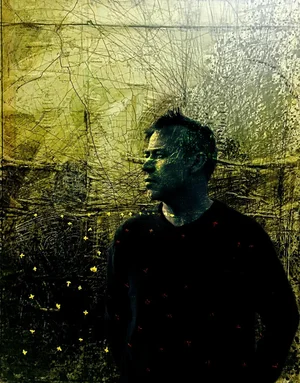
The High Clearing is my fourth local tome following on from Ballad of the Streets, The Streets of My Hometown, and the aforementioned A Mother Town Anthology. And I’m once again joined by Ian R. Pearsall and Phil Shallcross who have provided a series of quite brilliant illustrations; they never fail to impress. And I have to make a very special mention for Phil’s work on the book’s incredible cover. The three of us agreed that the one thing that symbolised Hanley was the Man of Fire, and Phil took a photograph he’d taken of the old beast and turned into something what is a quite breath taking piece of art.
But although the book is quite personal to me, it is equally so to Ian, whose family has historic roots in Birches Head, Northwood, and Joiners Square. Two of the books chapters explore these neighbourhoods and Ian’s relationship with them. I hope I have done these little places, my friend and his family justice. Time will tell.
There are many from my generation that have given up on Hanley, and while you can have a certain amount of sympathy, I can’t completely buy into that. Hanley is a part of me, and even when the town envelopes me in sadness, I can still come away thinking and dreaming of better days.
Dave Proudlove
September 2026